Read in English / 阅读语言  ไทย
ไทย  简体中文
简体中文
ได้ครับ English version พร้อมลงเว็บ:
Tetsuya Ishida and the Paintings Born from a Lost Era
Tetsuya Ishida was one of the Japanese artists whose work most directly and painfully reflected the social wounds of the late twentieth century. Gagosian is presenting its first exhibition in France dedicated to Ishida, offering a lens into the life of an artist who came of age during Japan’s “Lost Decade” of the 1990s — a period marked by severe economic stagnation, mounting social pressure, and a suffocating sense of uncertainty for the working generation.
His paintings can therefore be read as social records: images that capture confusion, despair, and the loss of self through a visual language that is at once realistic and surreal.
Faceless Figures and a World That Consumes the Human Body
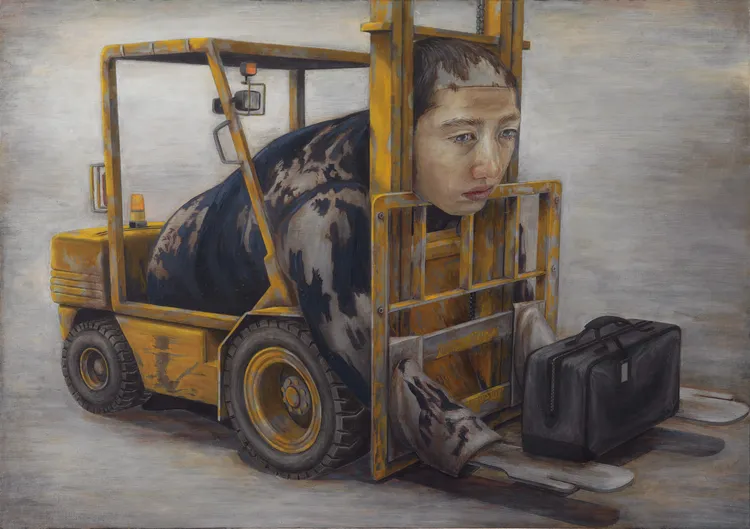
The central figures in Ishida’s paintings are often young men or workers whose expressions appear blank and emotionless, as if their identities have been erased, leaving behind only bodies that continue to exist within a system.
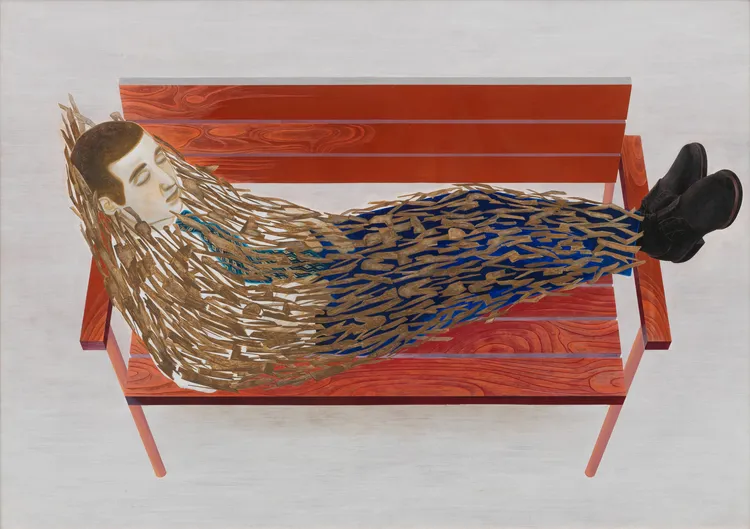
In The Sleeping Bag Worm (1995), a man in a suit sleeps on a bench, his body wrapped in a cocoon-like form that suggests both protection and confinement at the same time.
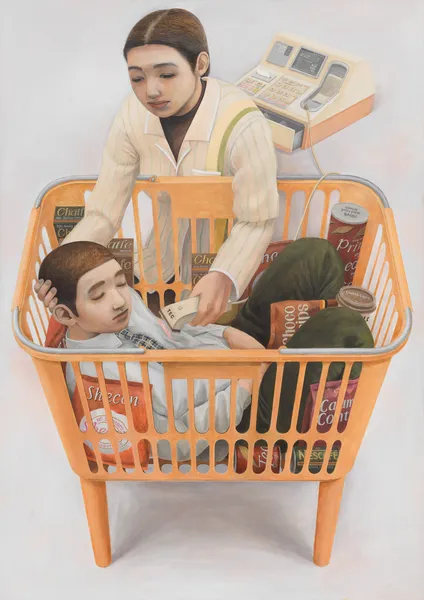
Meanwhile, Convenience Store Mother and Child (1996), one of Ishida’s most familiar images, depicts a male figure curled up inside a shopping basket that functions like a baby cradle. A woman stands over him, both cradling his head and scanning a barcode on his body. The image carries multiple overlapping meanings: infant, worker, and commodity. It also echoes Michelangelo’s Pietà, adding another layer of art-historical resonance.
Capitalism, Machines, and the Body as Commodity
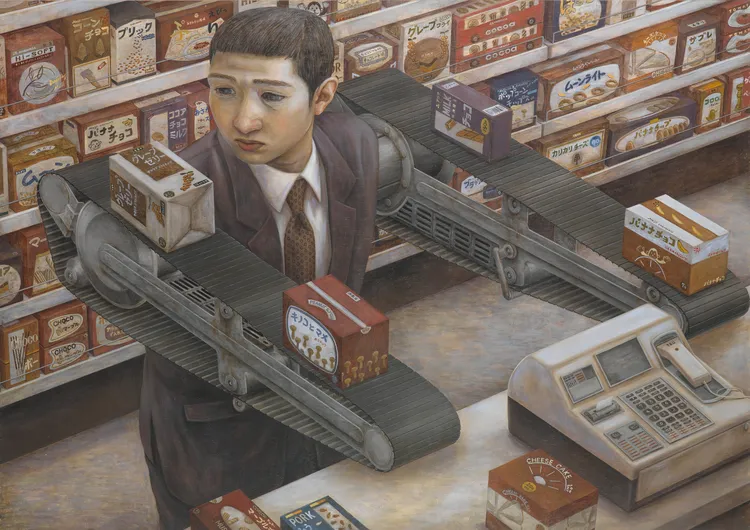
Supermarket (1996) shows a man in a suit whose arms have been replaced by conveyor belts. He stands between a cash register and shelves of goods, as though his own body has become part of the machinery of production and consumption. The painting is a sharp symbol of how the human being is swallowed by the system of late capitalism.
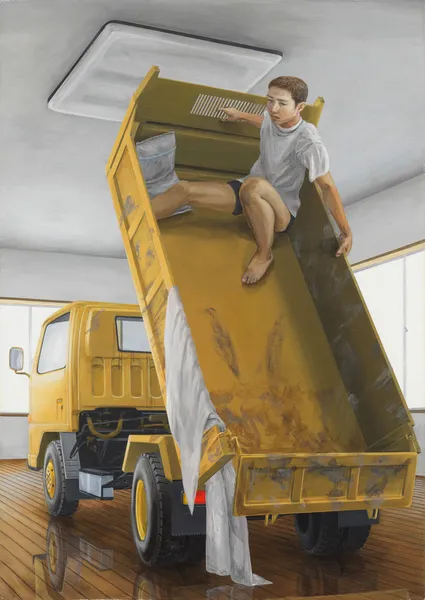
In Getting Up (1999), the bed is replaced by the raised bed of a dump truck, with the figure struggling against gravity to keep himself from falling.
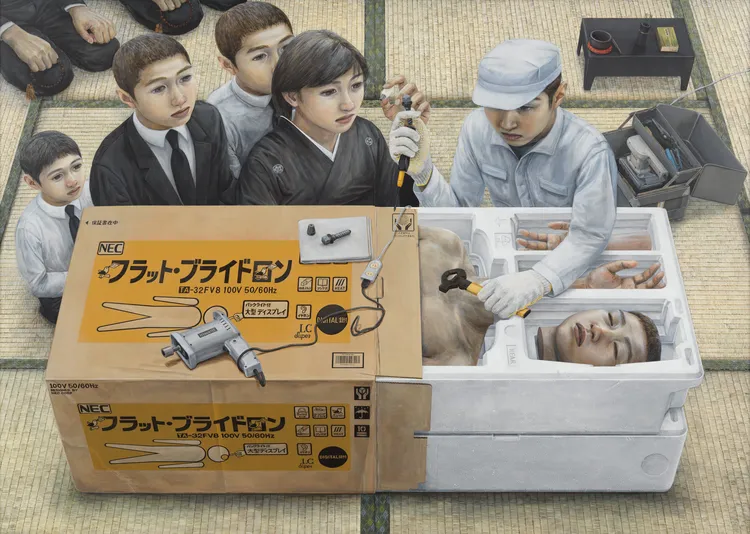
Recalled (1998), one of Ishida’s most incisive works, presents a family dressed in mourning, kneeling on tatami mats as technicians inspect the body of a man. The deceased figure’s head and hands have been separated and placed inside a box that resembles both a coffin and electronic packaging. It is a chilling critique of a society in which everything is turned into a product — even death.
Ishida’s paintings draw from Social Realism, Surrealism, and Japanese pop culture, fusing them into a distinctive and powerful visual language. Their impact becomes even stronger when one considers that Ishida died in 2005 at the age of only 32, leaving behind a body of work that stands as evidence of how deeply art can record the spirit and wounds of an era.
Tetsuya Ishida at Gagosian Paris: Visitor Information
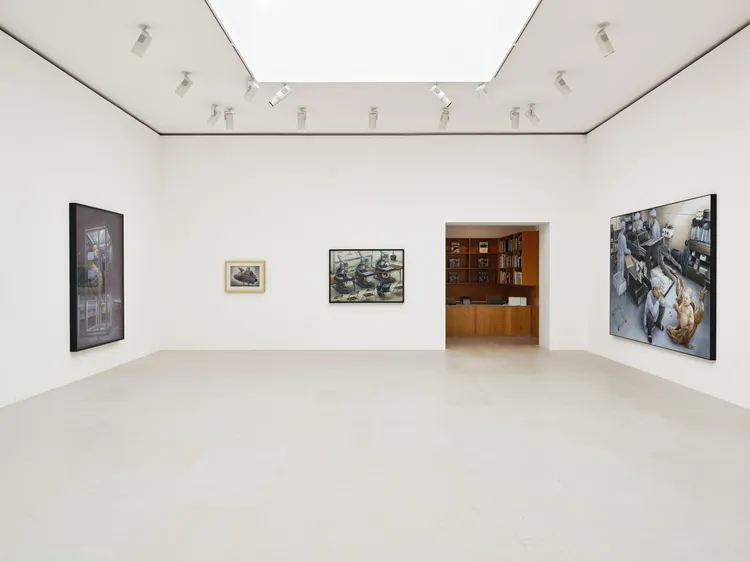
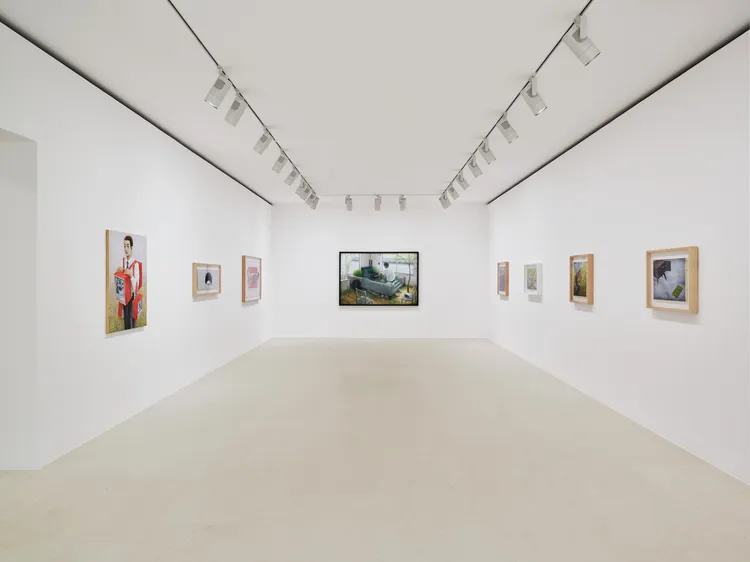
The exhibition Tetsuya Ishida officially opens with an opening reception on Wednesday, June 10, 2026, from 6:00 to 8:00 p.m., and will remain on view through July 31, 2026, at Gagosian, 4 rue de Ponthieu, Paris, France.
Story: Tae Art Man
