Read in English / 阅读语言  ไทย
ไทย  简体中文
简体中文
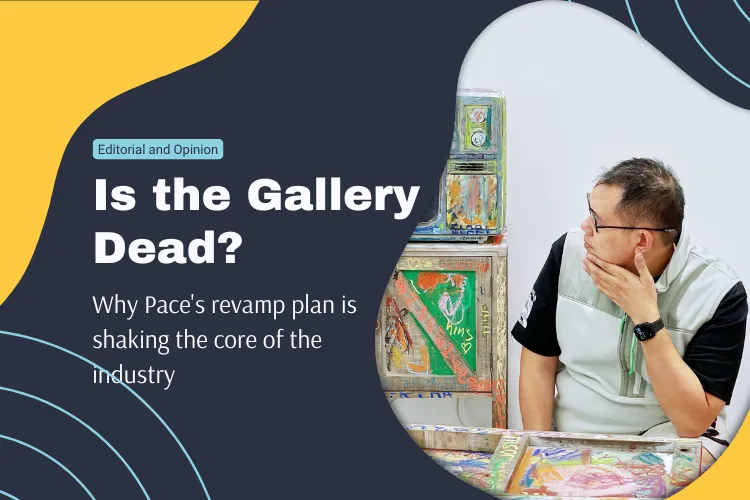
Why Pace’s revamp plan is shaking the core of the industry
When Marc Glimcher, the chief executive of Pace Gallery, said publicly that the gallery model was not simply broken but “unfixable,” he was not making an offhand remark. He was naming a crisis that many in the art world had quietly sensed for years but rarely said out loud.
Pace’s sweeping restructuring in 2026 is not just corporate news. It is a question aimed squarely at the foundation of the mega-gallery business model — a structure that has, for decades, functioned as the backbone of the contemporary art market.
Is this the moment that shift finally became unavoidable?
For much of the last several decades, large galleries grew through a strategy of expansion: more artists, more branches, more presence at global art fairs. The goal was to occupy territory, both geographically and psychologically, cementing influence across the market.
But in the world after 2010 — particularly as digital acceleration reshaped how art is bought, sold, and discovered — that model began to reveal hidden costs that outweighed its returns. Representing a large roster of artists no longer guaranteed value creation for each individual artist. Instead, it became a structural burden: harder to manage, harder to sustain relationships, harder to build long-term markets for every name on the list.
Compounding this, a familiar complaint has surfaced repeatedly across large galleries — a perceived lack of genuine understanding of the artists themselves. Communication from these institutions has often implied, whether intentionally or not, that the gallery itself is not particularly invested in the artist as a person or a practice.
Pace’s decision to cut more than 50 artists from its roster and reduce staff by roughly 20 percent is therefore not simply downsizing. It reads more like a strategic retreat — a repositioning exercise rather than an outward expansion.
This shift aligns closely with what has already been happening across the art world over the past decade. Today’s artists no longer rely on galleries as their sole channel to the market. The rise of social media and livestreaming has allowed artists to reach collectors directly, building their own narratives and communities without needing to pass through traditional intermediaries.
In this context, a gallery’s value is no longer rooted in being a gatekeeper. It must instead reposition itself as a builder of ecosystems — a support structure that helps artists develop their practice and contributes to the broader growth of the art world.
The real question, then, is not whether Pace is weak. It is whether Pace — and by extension, the industry — is adapting fast enough to a game whose rules have already changed.
And the larger question looms over the entire sector: will other major international galleries follow suit?
In hindsight, the signs were there all along. Pace’s closure of its Hong Kong location in 2025 appeared, at the time, to be an isolated event. Today, it looks more like the opening move in a broader process of recalibration — one whose consequences are only now becoming visible.
Seen this way, this is not merely a story about Pace. It is a case study for the entire industry.
For artists, this is an era of growing leverage — but one that comes with the added responsibility of building their own identity and market presence. For collectors, it is a moment in which the role of the intermediary is being redefined, a shift that carries both opportunity and risk in equal measure.
In the end, what Pace is doing may not be a retreat at all. It may be an attempt to return to the most fundamental question underlying the entire gallery system: in a world where everyone can connect directly, what is a gallery actually for?
The answer to that question will likely shape the direction of the global art market for the decade to come.
Tae Art Man
