Read in English / 阅读语言  ไทย
ไทย  简体中文
简体中文
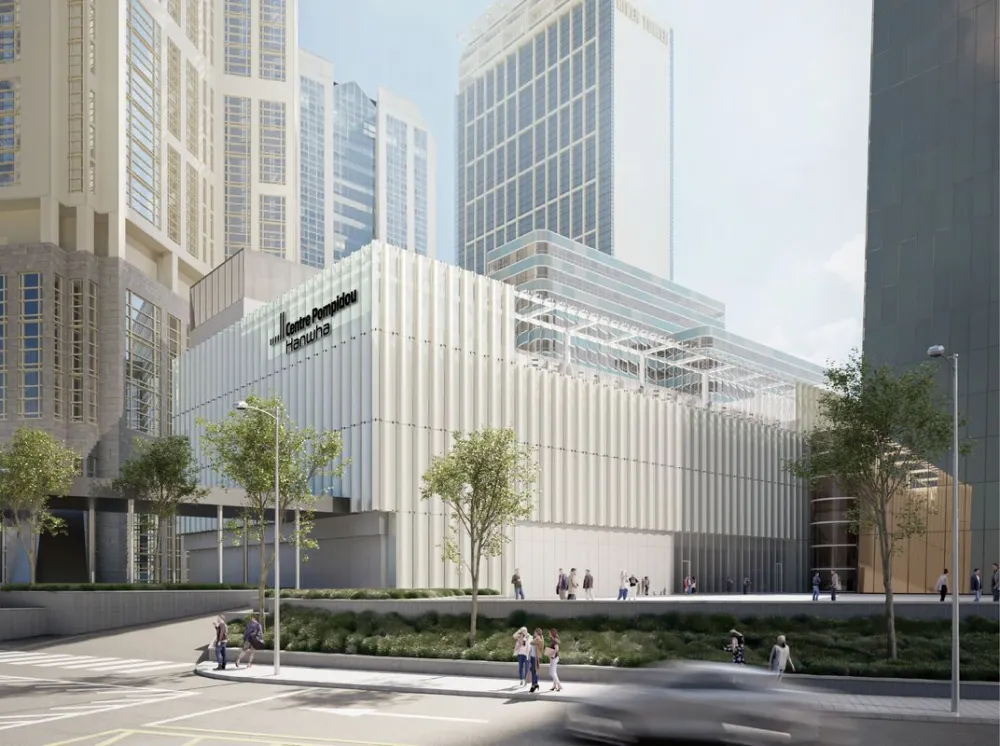
Centre Pompidou, the landmark Paris institution for modern and contemporary art, has opened a new branch in Seoul, South Korea, under the name Centre Pompidou Hanwha. The project, launched in partnership with the Hanwha Foundation of Culture, arrives as more than a museum expansion. It is positioned as a cultural bridge between Korea and France, and as a new platform for contemporary art in Asia at a time when major cities across the region are competing to define the next chapter of the global art map.
The museum is located inside the 63 Building in Yeouido, Seoul’s major financial district. The site occupies a former annex space that once housed an aquarium, now transformed by French architect Jean-Michel Wilmotte into a contemporary art institution at the heart of the city. Spanning more than 10,000 square metres, the venue includes two large exhibition galleries designed to host presentations from the Centre Pompidou collection as well as contemporary programmes developed in dialogue with Korea’s artistic landscape.
Architecturally, the new space has been conceived as a “box of light”. By day, the building is designed to draw natural light into its interior. By night, it glows outward toward the city, turning the museum into a luminous presence within the Yeouido skyline. Its translucent double-glazed façade also evokes the curves of traditional Korean roof tiles, suggesting that Centre Pompidou Hanwha is not simply transplanting a European museum brand into Asia. It is attempting to situate itself within Seoul’s architectural and cultural context.
Opening with The Cubists: Inventing Modern Vision
The inaugural exhibition of Centre Pompidou Hanwha, The Cubists: Inventing Modern Vision, opened on June 4, 2026. Presented across the museum’s two main galleries, the exhibition occupies more than 3,000 square metres and has been developed through a direct curatorial collaboration between teams in Paris and Seoul.
The exhibition traces the birth, expansion and international influence of Cubism through a chronological framework. Drawing from the Centre Pompidou collection, it brings together around 90 works by more than 40 artists, including Pablo Picasso, Georges Braque, Juan Gris, Fernand Léger, Sonia Delaunay and Robert Delaunay. Rather than presenting Cubism merely as a closed chapter in Western art history, the exhibition frames it as a visual revolution that changed how artists understood space, form and perception in the 20th century.
A dedicated KOREA FOCUS section extends this narrative into the Korean context. Through visual art, photography, literature and dance, it examines how Western Cubism and avant-garde ideas intersected with the formation of modern Korean art. This gives the exhibition a more layered significance. It is not simply an import of European modernism into Asia, but an attempt to stage a conversation between Paris and Seoul, a curatorial model that has become increasingly visible in major international museum projects.
According to Centre Pompidou and the Hanwha Foundation of Culture, the Seoul institution will initially present two exhibitions a year drawn from the Centre Pompidou collection. Alongside these, it will develop exhibitions devoted to contemporary Korean artists and major currents in international art, supported by cultural and educational programmes for audiences in South Korea. This makes clear that the institution’s ambition is not merely to become a destination for masterpieces from Europe, but to embed itself within Korea’s art ecosystem over the long term.
From Paris to Shanghai, and Now Seoul
This is not the first time Centre Pompidou has expanded its role in Asia. The Paris institution previously launched the Centre Pompidou x West Bund Museum Project in Shanghai, which officially opened on November 6, 2019. That project was framed as a major platform for cultural exchange between France and China, covering loans from the collection, jointly developed exhibitions, public programmes and museum professional training.
In 2023, the Shanghai partnership was extended for another five years, confirming that Centre Pompidou’s international strategy is no longer experimental. It is becoming a long-term institutional model. The Seoul branch should therefore be read within a broader strategy, one in which Centre Pompidou is using its collection, curatorial expertise and symbolic capital to build a network beyond France.
More Than a New Pompidou Branch, a Strategic Move for Seoul
Centre Pompidou Hanwha is the latest move in Centre Pompidou’s growing constellation of international and regional sites. The institution already has a presence in Metz, France, and Málaga, Spain, while further projects have been planned in Brussels and Foz do Iguaçu, Brazil. Taken together, these developments show that Pompidou no longer sees itself only as a national museum anchored in Paris. It is increasingly operating as an international network of cultural institutions.
For Seoul, the timing is equally important. Over the past several years, the city has strengthened its position in the Asian art world through museum investment, a growing gallery scene, major international exhibitions and the arrival of global art fairs. The opening of Centre Pompidou Hanwha adds another layer to this trajectory. It gives Seoul not only another museum, but another symbol of cultural legitimacy in a region where Hong Kong, Shanghai, Tokyo and Singapore are all competing for attention, capital and institutional influence.
In this sense, Centre Pompidou Hanwha is not simply a story about a new museum opening. It is a signal of how cities now compete for cultural power. Collections, visitors, funding, artists, curators and international prestige have become part of a larger urban equation. For Seoul, having the Centre Pompidou name placed inside the 63 Building, in the middle of a financial district, is a powerful statement about where the city wants to stand in the coming decade.
Centre Pompidou Hanwha: Exhibition Information
The Cubists: Inventing Modern Vision is on view at Centre Pompidou Hanwha, 63 Building, 50 63-ro, Yeongdeungpo-gu, Seoul, from June 4 to October 4, 2026. The museum is open Tuesday, Thursday, Friday and Sunday from 10am to 6pm, and Wednesday and Saturday from 10am to 9pm. It is closed on Mondays. General adult admission is 28,000 Korean won, or approximately USD 18, with discounted admission available for children, teenagers, seniors and eligible visitors. Advance reservation is recommended through the official Centre Pompidou Hanwha website.
You can watch my analysis of this development on YouTube channel Tae Art Man.
Story: Tae Art Man
