Read in English / 阅读语言  ไทย
ไทย  简体中文
简体中文
AI Art and a Trap Set in Plain Sight
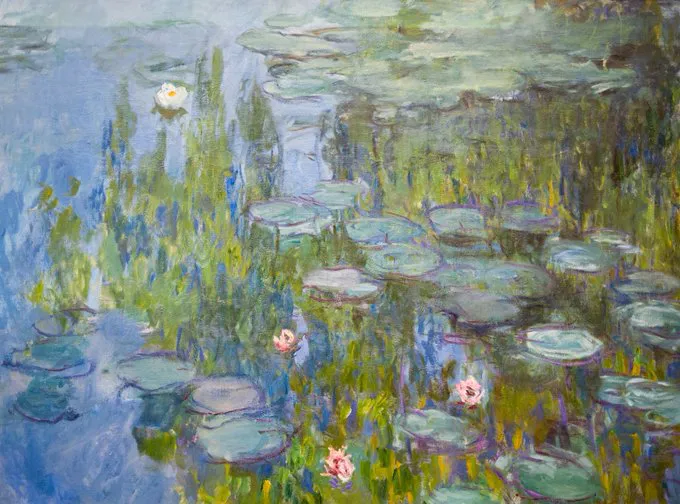
AI Art became the center of a sharp social experiment when conceptual artist SHL0MS posted a cropped section from Claude Monet’s Water Lilies series on X, formerly Twitter, and told followers it had been generated by artificial intelligence.
The image, taken from a Monet work painted around 1915 at Giverny, was presented with a deceptively simple question: “In what ways is this image inferior to a Monet?”
The response was immediate. Thousands of users began dissecting the image in detail, many of them convinced they were looking at a machine generated imitation rather than a fragment of an actual painting by one of the most celebrated figures in Impressionism.
Some argued that the surface lacked Monet’s impasto. Others claimed the light felt unnatural, the spacing between the flowers seemed strange, or the canvas lacked the organic texture and physical irregularity one might expect from an original painting.
The most repeated criticism, however, was also the most revealing. Many users said the image had “no soul.”
When the Label Changes the Way We See
The experiment became compelling not because the image itself changed, but because the information surrounding it changed the way people looked at it.
If the same image had been introduced as a Monet, many viewers might have searched for the artist’s genius, his sensitivity to light, or the atmosphere of his late garden paintings. But once the work was framed as AI, the act of looking shifted almost instantly into an act of suspicion.
The image was no longer being read as a painting. It was being inspected as evidence.
Some viewers attempted to identify flaws that could prove the supposed artificiality of the image. Others treated the picture less as an artwork and more as a technical failure waiting to be exposed.
Yet there were also a smaller number of more neutral responses. Some users praised the image, saying that if it had truly been generated by AI, it represented an impressive ability to capture the atmosphere and detail of Monet’s original work. A few even suggested that it might be among the strongest examples of AI image generation available at the time.
That minority reaction only made the experiment more interesting. It showed that what people believed about the image could strongly influence what they thought they saw in it.
The Reveal That Sent Comments Disappearing
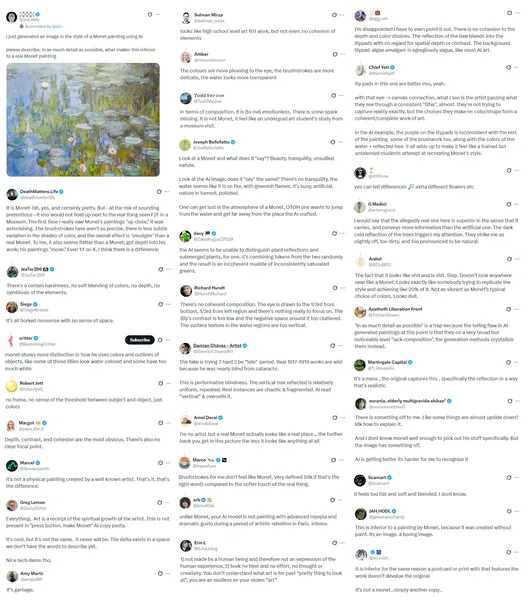
After the comments had accumulated, SHL0MS revealed the truth. The image was not made by AI. It was a cropped section of an actual Monet painting.
The revelation quickly changed the mood of the conversation. Some of those who had previously criticized the image began deleting their comments. But by then, it was too late. SHL0MS had already captured and reposted some of the reactions.
At that point, the project moved beyond a simple online prank. It became a conceptual artwork about judgment, authority and the instability of aesthetic confidence in the age of AI.
The question was no longer whether AI could make images that resemble art. The more uncomfortable question was whether viewers were judging the image itself, or judging the label attached to it.
From Social Experiment to NFT
Following the experiment, SHL0MS minted the image as an NFT on Ethereum under the title “inferior image.”
The work was acquired by digital art collector Jediwolf for 18.988 ETH, or around USD 42,000, after 28 bids.
Jediwolf later wrote that the past 24 hours had taught people a great deal, not about art or AI, but about themselves. The collector added that it was difficult to imagine anything more valuable than that realization.
That statement may be one of the clearest readings of the work. SHL0MS did not merely ask whether AI can make a convincing image. The project pushed viewers toward a deeper question: do we judge art through what we actually see, or through what we have already decided to believe?
The Image Stayed the Same. The Viewer Changed.
This social experiment reveals something uncomfortable about the current debate around AI Art.
When the same image is described as a Monet, viewers may search for genius, history and emotional depth. But when the same image is described as AI, many quickly search for defects, artificiality and proof that it lacks artistic legitimacy.
That does not mean all criticism of AI images is invalid. There are real questions around authorship, labour, copyright, originality and the ethics of training data. But SHL0MS’s experiment exposes another layer of the debate: the role of bias before the act of looking even begins.
Perhaps the problem is not always in the image.
Sometimes, it may be in the mind of the viewer.
Story: Tae Art Man
