Read in English / 阅读语言  ไทย
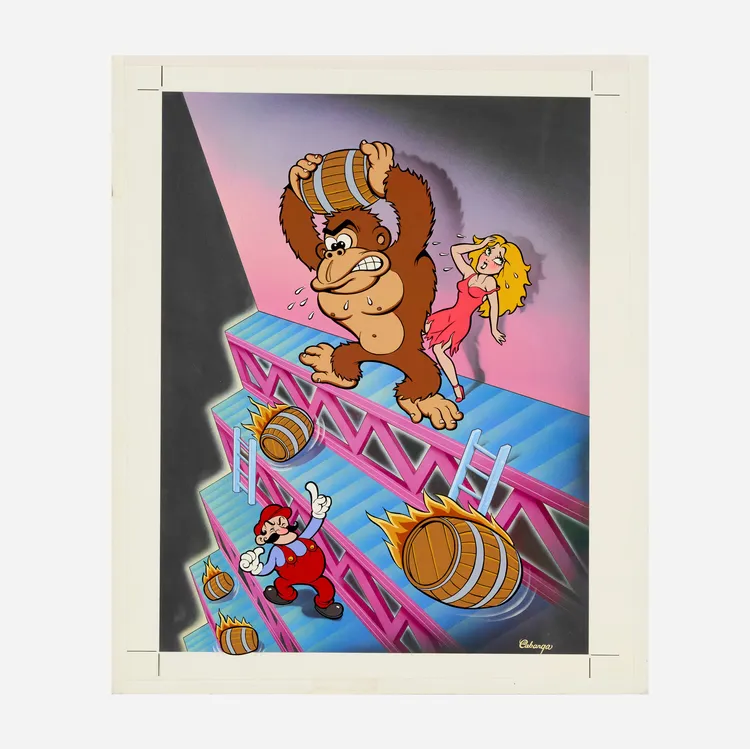
Donkey Kong’s original 1981 promotional artwork has set a new auction record for video game art, selling for $329,400 at Landry Pop Auctions on October 28, 2026. The painting, created for Nintendo’s North American arcade marketing campaign, had narrowly escaped being discarded during an office cleanout decades earlier. Today, it stands as a significant surviving artifact from the early history of one of the world’s most recognizable video game characters, Mario.
Illustrated by Leslie Cabarga, the artwork captures an important moment in Nintendo’s history, when Mario was still known as Jumpman, years before the release of Super Mario Bros. in 1985. Landry Pop Auctions identifies the illustration as the character’s first public appearance, making its survival particularly significant to collectors and historians of video game culture.
Donkey Kong: The Artwork That Introduced Mario
The painting, titled Donkey Kong North American Arcade Flyer Original Art, was commissioned in 1981 to promote Nintendo’s arcade game in the North American market. Created by American illustrator Leslie Cabarga, it depicts Donkey Kong holding a wooden barrel above his head while Jumpman climbs a towering structure to rescue Pauline.
Rather than reproducing the limited pixel graphics of the original arcade game, Cabarga developed an expressive illustration that brought the characters and their storyline to life. The composition presents a complete visual narrative, communicating action, danger, and character identity through a single promotional image.
Measuring approximately 50 × 42 centimeters, the artwork was produced using acrylic paint on a transparent acetate sheet, layered over ink and airbrush work on cardstock. This combination of traditional illustration techniques reflects the production methods used in commercial graphic design before digital tools became widespread.
The painting also documents an important period in Nintendo’s development. Following the disappointing commercial performance of its earlier arcade game Radar Scope, Nintendo introduced Donkey Kong in 1981, helping establish the company’s presence in the American arcade market.
The game’s central character, initially called Jumpman, would later be renamed Mario. He went on to become the protagonist of Mario Bros. in 1983 and Super Mario Bros. in 1985, eventually developing into one of the most recognizable figures in global entertainment.
A Historic Painting Rescued From the Trash
The survival of Cabarga’s painting is particularly remarkable given that it was once destined for disposal.
During an office expansion at Nintendo of America in the late 1980s, Donna Darbous, a former advertising executive at the company, discovered several original illustrations among materials being discarded. With permission from her supervisor, she rescued a selection of artworks, including the original Donkey Kong painting.
At the time, these illustrations were considered outdated promotional materials rather than historically valuable collectibles. Their significance would become apparent only decades later, as Nintendo’s characters developed into internationally recognized cultural icons.
Darbous preserved the works for years before rediscovering them while sorting through her belongings. According to Landry Pop Auctions, she eventually found the rescued illustrations stored inside a coffee table, alongside other artworks she had collected.
The discovery ultimately led her to contact Travis Landry, founder of Landry Pop Auctions, bringing the collection to the auction market.
What might otherwise have disappeared during an ordinary office cleanout has consequently become an important record of Nintendo’s early creative and commercial development.
Donkey Kong Breaks the Video Game Art Auction Record
The painting was initially estimated to fetch between $100,000 and $150,000. However, the final sale price reached $329,400, more than twice its upper estimate.
The result also surpassed the previous auction record for original video game artwork, held by Robert Florczak’s original cover illustration for Prince of Persia (1989), which sold for $63,000 at Heritage Auctions in January 2023.
With a sale price approximately 5.2 times higher than the previous record, the Donkey Kong painting established a new benchmark for the category.
The artwork was the centerpiece of Landry Pop Auctions’ Jumpman: The Beginning of an Icon sale, an event dedicated to original artworks and historical objects associated with Nintendo’s formative years.
Other notable results included early Super Mario Bros. production artwork featuring Mario and Luigi, which sold for $17,080, and an original 1985 Super Mario Bros. cartridge for the Nintendo Entertainment System (NES), graded 8.0, which fetched $34,160.
From Commercial Illustration to Cultural Heritage
The record-breaking sale offers an interesting perspective on how the market increasingly recognizes the historical importance of original artwork from the video game industry.
Unlike rare game cartridges or vintage consoles, original production paintings preserve evidence of the creative processes behind a game’s visual identity. They reveal how illustrators, designers, and commercial artists translated characters and fictional worlds into imagery capable of reaching audiences beyond the screen.
Such works are especially significant for productions created before digital illustration became standard practice. Many promotional images from this period were produced through combinations of hand-painted artwork, photographic reproduction, and traditional printing techniques. Surviving originals therefore provide valuable material for studying the visual culture and commercial design practices of their era.
In the case of Donkey Kong, the painting’s cultural significance is inseparable from Mario’s transformation from an arcade character into a global entertainment icon. The illustration represents an early stage in the development of a visual identity that would become familiar to generations of players.
Its $329,400 auction result also illustrates how an object’s perceived value can change as its historical context becomes more significant. A painting originally commissioned for a commercial advertising campaign has become a collectible recognized for both its artistic production and its connection to popular culture.
While a single record-breaking sale does not necessarily establish a broader market trend, the Donkey Kong result demonstrates the potential value of surviving original artworks associated with influential entertainment franchises.
More than four decades after its creation, an illustration once considered disposable promotional material has become one of the most valuable examples of original video game art sold at auction.
For additional information and images of the original artwork, visit Landry Pop Auctions.
Story: Tae Art Man
